A paper · November 2026
Flat galaxy rotation curves from a Bennett-pinch plasma current
A two-parameter test on 175 SPARC galaxies
Download the PDF on Zenodo Concept DOI (latest version) Local PDF copy How to cite
Plain-language summary
Galaxies spin faster at their edges than their visible stars and gas can explain with gravity alone. This paper tests a simple electric-current model: a current running along each galaxy’s axis in a Bennett-pinch profile, whose magnetic force adds to gravity.
Using two fitted numbers per galaxy, the model matches the measured rotation curves of 175 galaxies from the SPARC database within their error bars in 73% of cases (median reduced χ² of 0.71). Visible-matter gravity alone does so in 3% of cases. Under the same fitting procedure, a two-parameter Burkert dark-matter halo reaches a median of 0.71 and 70% under 2; an NFW halo reaches 1.28 and 59%; and a two-parameter MOND-style fit reaches 1.35 and 64%.
The two numbers are fitted for each galaxy, not predicted from other properties. Making the model work requires large currents, and in some galaxies fields stronger than those usually measured. It also requires the electromagnetic force on charged gas to be carried over to neutral gas and stars. The paper lists predicted magnetic-field strengths and Faraday-rotation patterns for every galaxy, which radio surveys such as LOFAR and the Square Kilometre Array (SKA) can check independently of the rotation curves.
The underlying ideas and data are those of earlier authors. This paper does not claim priority for them. Its contribution is a uniform two-parameter Bennett-pinch fit to all 175 SPARC galaxies, and a comparison with Burkert, NFW and MOND models run through the same procedure.
Same-procedure comparison
All four models in the table have two free parameters. They were fitted to the same 175 SPARC rotation curves, with the same uncertainties, the same treatment of stellar mass-to-light ratios (except that the MOND-style fit also varies the disk mass-to-light ratio), the same optimizer, and the same degrees-of-freedom counting.
| Model (two parameters each) | Median reduced χ² | Galaxies with χ² < 2 | Bennett pinch is lower in |
|---|---|---|---|
| Bennett pinch | 0.706 | 73% | — |
| Burkert dark-matter halo | 0.710 | 70% | 117 of 175 |
| NFW dark-matter halo | 1.28 | 59% | 135 of 175 |
| MOND (two-parameter RAR fit) | 1.35 | 64% | 128 of 175 |
On the median, the Bennett-pinch model and the Burkert halo are nearly tied (0.706 versus 0.710). The Bennett-pinch model has the lower χ² in 117, 135 and 128 of the 175 galaxies against Burkert, NFW and MOND respectively, and the lowest summed χ² over the full sample.
Figures
Three figures from the paper are shown below. High-resolution versions are in the PDF.
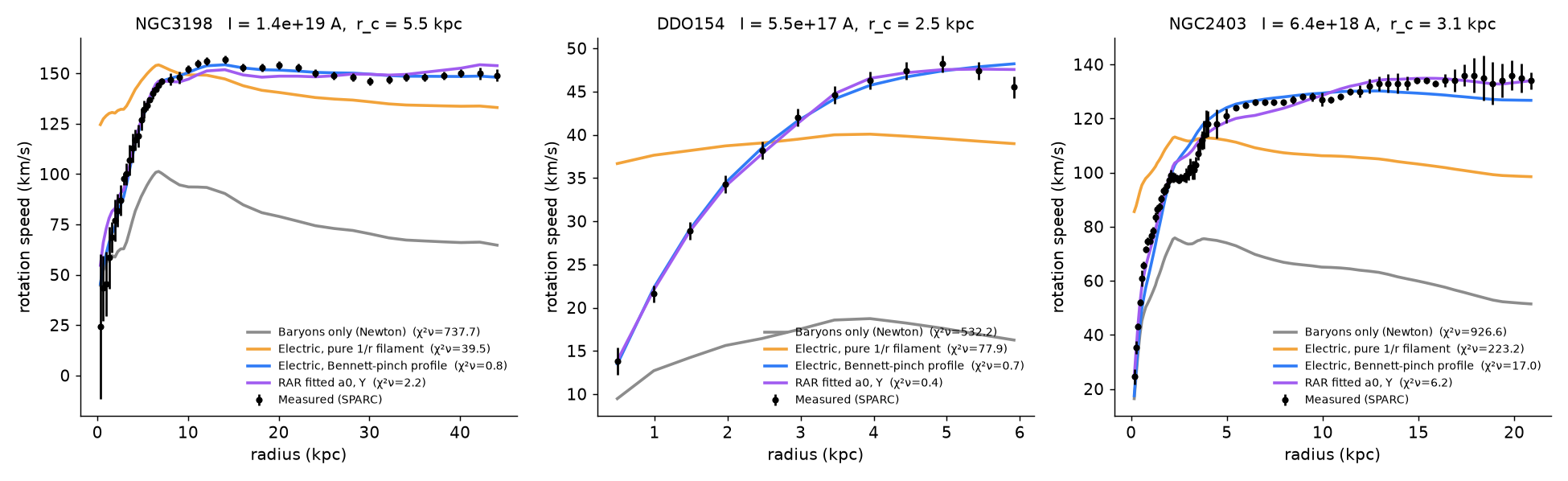
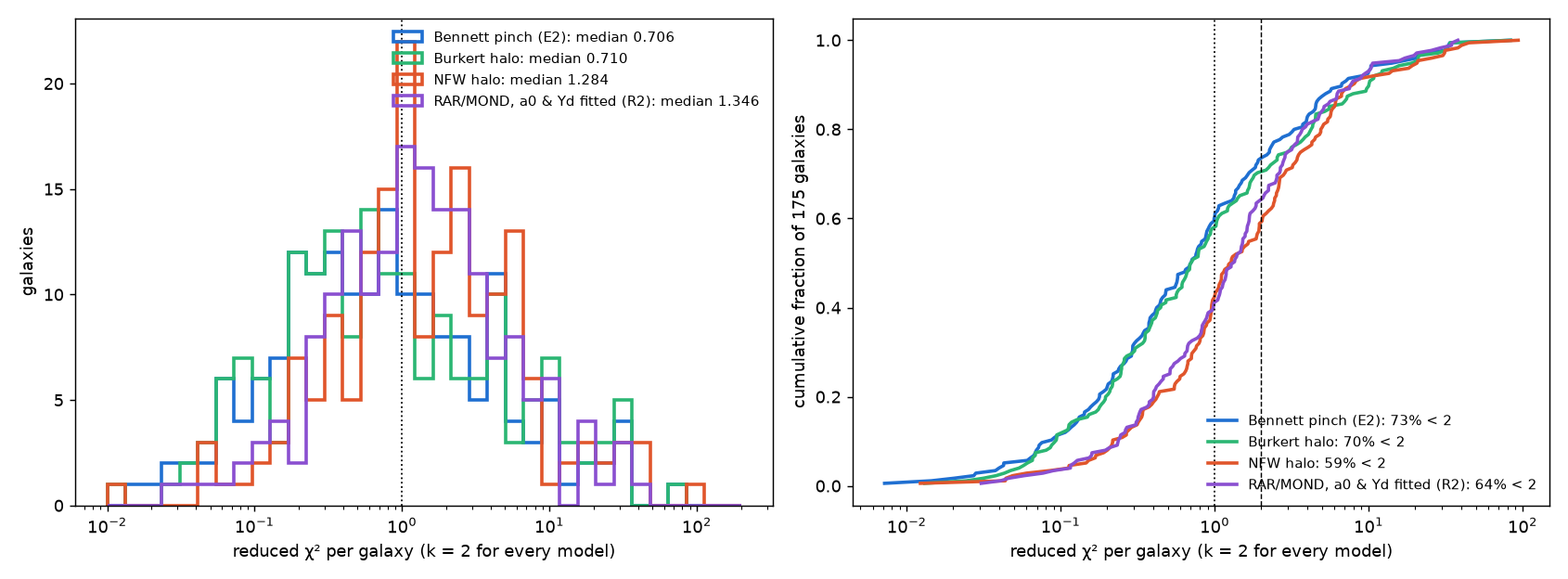
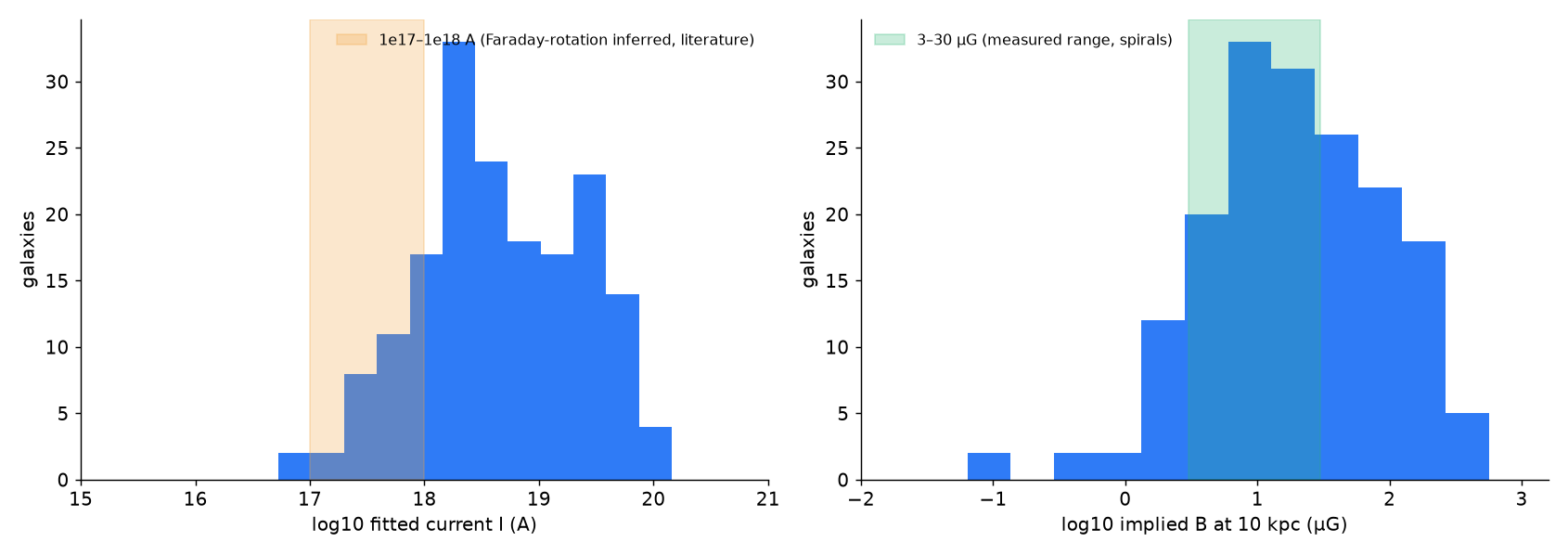
What would test it
The model predicts a definite magnetic-field strength, radial field profile, and field-sign pattern for every galaxy. Those predictions are independent of the rotation curves used to fit the model, and radio polarization and Faraday-rotation surveys can check them.
- Field strength. The paper lists a predicted azimuthal field at 10 kpc for each of the 175 galaxies (assuming a 1 kpc current path; the field scales as the inverse square root of that path). The largest predicted values are in UGC 2487, NGC 6674, NGC 5985, NGC 2841 and ESO 563-G021. Equipartition field estimates from synchrotron surveys would test those numbers directly.
- Radial profile. The field is predicted to rise in proportion to radius inside the fitted core (median 3.4 kpc) and to fall as 1/r outside it. Resolved field-strength profiles from deep radio continuum maps can be compared with that shape.
- Field geometry and sign. An axial current produces an azimuthal field that circles the axis in one direction throughout the disk. In Faraday-rotation maps of an inclined disk, the rotation measure would then be largest in magnitude near the major axis and would reverse sign across the minor axis, with no large-scale reversals with radius. Reversals with radius in a given galaxy would conflict with a single axial current.
Current LOFAR observations, and future Square Kilometre Array (SKA) surveys of polarized emission and background-source rotation measures, have the sensitivity and resolution intended for this kind of measurement in nearby disk galaxies.
Requirements and limitations
The fit to the rotation curves is real under the stated assumptions. The physical requirements are large, and they are stated here as quantities.
- Currents. With a 1 kpc path length, 83% of the galaxies require a current greater than 1018 A, which is about the largest current inferred so far from Faraday rotation (the jet in 3C 303). The median requirement is 4.3 × 10¹⁸ A.
- Magnetic fields. For 36% of the galaxies, the implied field at 10 kpc exceeds 30 μG, the upper end of the 3–30 μG range reported for spiral galaxies. The median is 15 μG, and for 53% of the galaxies the implied field falls within that measured range.
- Coupling to neutral matter. Rotation speeds are measured in mostly neutral hydrogen and in stars. The model requires the electromagnetic force on the ionized component to be transferred to both. No ion–neutral coupling rate or stellar coupling mechanism is computed in the paper.
- Fitted, not predicted. The two parameters are fitted separately for each galaxy. They are not predicted from other measured properties, so the model does not yet predict a rotation curve from photometry alone.
- What is not modelled. No return current, energy source, or time evolution is modelled, and the stability of the configuration is not checked. The model treats the disk as thin and axisymmetric, while measured galactic fields have spiral and halo structure that is not compared here.
Published critiques of magnetic support for rotation curves are discussed in the paper. The present fits do not rebut those objections. Cuddeford & Binney (1993) argued that a field strong enough to flatten a rotation curve would make the gas disk flare unacceptably. Jokipii & Levy (1993) argued from the virial theorem that magnetic fields in an isolated galaxy are net expansive and cannot replace dark matter. Sánchez-Salcedo & Reyes-Ruiz (2004) concluded that azimuthal fields can contribute at most about 10 km/s at the outermost H I point without a dark halo (up to about 20 km/s with a halo).
Credits
This paper rests on the work of people who came up with an idea or added something new to it. It does not claim priority for those ideas or data. Its contribution is the uniform two-parameter test and the same-procedure comparison.
- Kristian Birkeland (1908)
- Identified field-aligned currents; the term Birkeland current follows that work.
- Willard H. Bennett (1934)
- Derived the self-focussing current-stream equilibrium — the Bennett pinch — that the model uses.
- Hannes Alfvén (1981, 1986)
- Described cosmic plasmas in terms of currents, circuits and double layers.
- Anthony L. Peratt and James C. Green (1983; Peratt 1986)
- Ran particle-in-cell simulations of interacting, galactic-scale current filaments, in which the interaction force varies as 1/r and produces flat rotation profiles.
- A. H. Nelson (1988)
- Showed that magnetic stress in the outer gaseous disk can raise rotation speeds above the gravitational speed of the visible matter.
- E. Battaner, J. L. Garrido, M. Membrado and E. Florido (1992, 1995)
- Developed an azimuthal-field account of flat rotation and a two-dimensional magnetohydrodynamic model of it.
- B. Ruiz-Granados, J. A. Rubiño-Martín, E. Florido, E. Battaner and J. Calvo (2010, 2012)
- Fitted a magnetic contribution, together with luminous mass and a dark halo, to the outer rotation curves of M31 and the Milky Way.
- D. Tsiklauri (2011)
- Fitted a J×B term, using a more realistic Galactic field model, to the Milky Way rotation curve.
- Lee Holmes (2026)
- Applied a magnetohydrodynamic boundary-stress analysis to the same 175 SPARC galaxies. That paper is the closest prior analysis of this sample; the present work uses a different model and a same-procedure comparison with halo and MOND fits.
- Federico Lelli, Stacy S. McGaugh and James M. Schombert (2016)
- Assembled the SPARC rotation curves and mass models and made them public. The original H I and H-alpha observers whose curves SPARC compiles are listed galaxy by galaxy in SPARC Table 1, as SPARC asks users of the data to note.
Known published critiques of magnetic support, discussed in the paper, are Cuddeford & Binney (1993), Jokipii & Levy (1993), and Sánchez-Salcedo & Reyes-Ruiz (2004).
How to cite
The concept DOI always points to the newest version:
Bagger, K. (2026). Flat galaxy rotation curves from a Bennett-pinch plasma current: a two-parameter test on 175 SPARC galaxies. Zenodo. https://doi.org/10.5281/zenodo.24357643
The current Zenodo record (version 2 at the time this page was built) is zenodo.org/records/24357644. Use the concept DOI if you want the link to keep resolving to the latest version.
BibTeX
@misc{bagger2026bennett,
  author       = {Bagger, Kirk},
  title        = {Flat galaxy rotation curves from a {Bennett}-pinch
                  plasma current: a two-parameter test on 175 {SPARC}
                  galaxies},
  year         = {2026},
  publisher    = {Zenodo},
  doi          = {10.5281/zenodo.24357643},
  url          = {https://doi.org/10.5281/zenodo.24357643}
}
PDF on Zenodo Concept DOI Local PDF copy
Use of AI tools
An AI assistant (Grok Bot) helped write the analysis code and draft the text. The author directed the work, checked the results, and takes full responsibility for the content.